Plate Size and Food Intake Perception

How dishware dimensions influence our perception of portion quantity and satiety signaling.

Introduction

One of the most researched topics in food science is how visual cues—particularly plate size—influence how much we perceive we are eating and how satisfied we feel. This body of research reveals that our eyes and brain process portion information in sophisticated and sometimes counterintuitive ways.

The Delboeuf Illusion

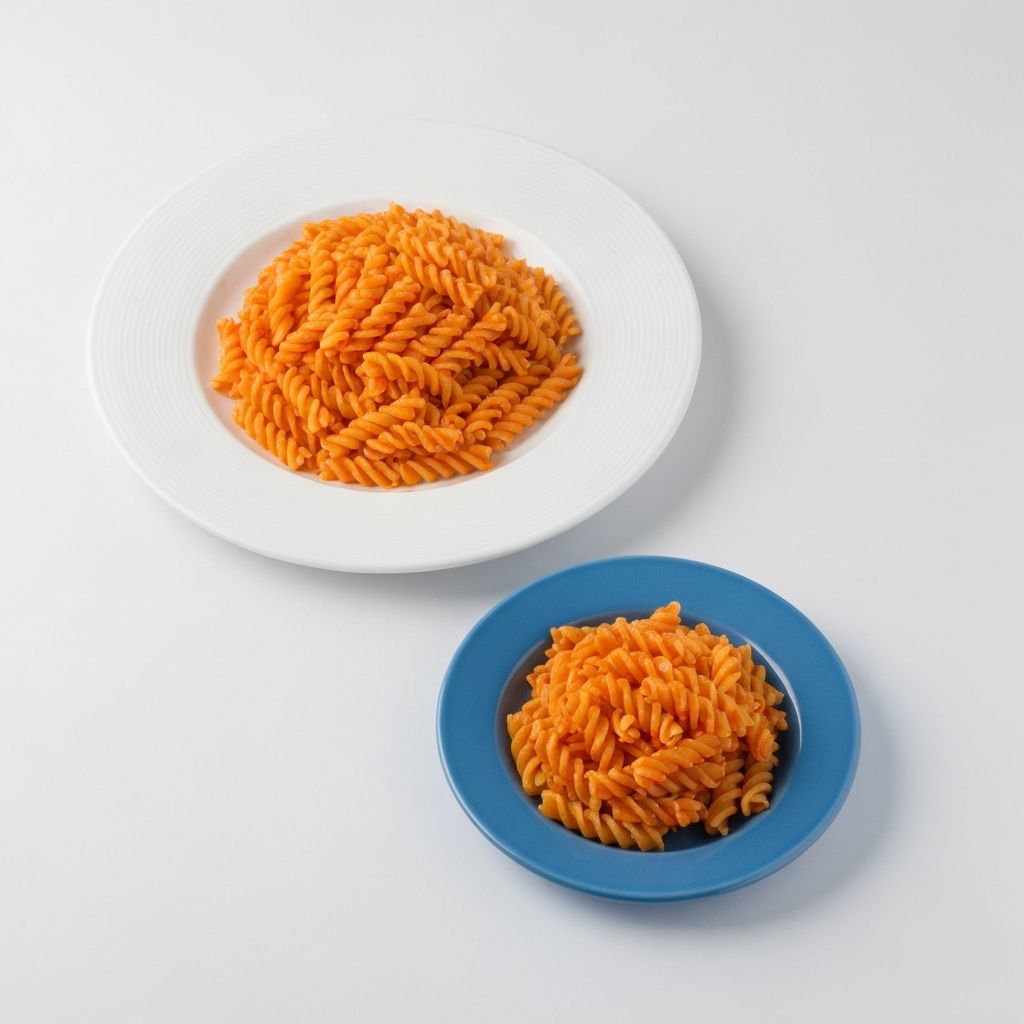
Same amount of food on different sized plates

The Delboeuf illusion is a visual phenomenon where a circle appears larger or smaller depending on the size of concentric circles surrounding it. Applied to dining, this means that the same portion of food appears visually smaller on a large plate and visually larger on a small plate.

Multiple research studies have demonstrated this effect influences actual consumption. When the same amount of food is plated on a larger dish, people report feeling less satisfied and often eat more to compensate.

The strength of this effect varies between individuals and is influenced by factors such as familiarity with the food, hunger level, and awareness of portion size. However, the illusion is measurable and consistent across diverse populations.

Research Evidence

Cornell University studies (2005-present): Research led by Brian Wansink demonstrated that participants served from a larger plate or bowl consumed significantly more, yet reported feeling equally satisfied as those eating smaller portions from appropriately-sized dishware.

British Journal of Nutrition (2012): Research indicated that individuals consuming from 10-inch plates ate approximately 22% less than those eating from 12-inch plates, while reporting similar satisfaction levels.

Environmental factors research: Studies show that plate color, placemat design, and other contextual elements also influence consumption—white plates may prompt different behavior than darker plates, depending on food color contrast.

The Complexity of the Effect

While the plate size effect is consistently demonstrated in research, its magnitude and practical significance remain debated. Some research suggests that the effect is modest and that other factors (such as actual hunger, food type, and social context) are more influential.

Additionally, awareness of the plate size effect can reduce or eliminate it. People who know they are being tested for the illusion often don't show the effect, suggesting that conscious awareness plays a role.

The effect also interacts with food type—the illusion may be stronger for some foods than others, and varies depending on whether people are serving themselves or being served.

Practical Context

Home dining: Using appropriately sized plates—neither too large nor too small—may support more accurate portion perception, though individual preference and food variety matter considerably.

Restaurant settings: The relationship between plate size and satiety is only one of many factors influencing how much people consume. Plate size, portions, pricing structure, social context, and marketing all interact.

Individual variation: The plate size effect is not universal. Some people are highly susceptible, others less so. Age, familiarity with portion guidance, and cultural background all influence the effect.

Research materials and data charts

Beyond Plate Size

While plate size is notable, research reveals that many environmental and contextual factors influence portion perception and consumption:

Serving format: Whether food is served on a plate, in a bowl, or in the original packaging influences consumption patterns.

Food visibility: Visible food encourages consumption; hidden food (in opaque containers) typically results in less intake.

Eating location: Eating while distracted (watching television, working) often results in consuming more than when eating without distraction.

Social context: Eating alone, with one other person, or in groups produces different consumption patterns.

Food composition: The actual nutritional content, fiber, water content, and how filling the food is matter more to satiety than visual cues alone.

Key Takeaways

The plate size effect is real and measurable, but modest and variable. Plate size is one of many factors influencing how much we consume and how satisfied we feel. More important factors include actual hunger level, food composition, eating environment, and individual variation.

Understanding that visual perception influences consumption can be useful context, but it's not a reliable tool for determining individual portion appropriateness, which depends on many factors.

Educational Information: This article explains research findings about portion perception. It does not constitute personal dietary advice. For guidance on your individual eating patterns or portion needs, please consult a healthcare professional.
Back to Blog